
Most people searching for “cheap Dihexa” are really asking a different question, whether they know it or not. They want to know if they’re about to waste money on something fake, or worse, something unaccountable. The sticker price is almost a decoy. What actually determines whether you got a good deal is what happens after the payment clears: whether the material is real, whether anyone answers for it if it isn’t, and whether the person selling it to you is honest about the fact that Dihexa, as of 2026, has never been tested in a human trial.
This piece walks through that worry in order, the way it actually shows up for a reader, and ends with a scorecard so you can see the math rather than take anyone’s word for it.
The worry underneath the price tag
Here is the quiet fear most buyers don’t say out loud: what if I pay less and get nothing, or pay less and get something no one can vouch for? A low price attached to a product you can’t verify, sold by someone with no license and no name you could ever call, isn’t a bargain. It’s a bet, dressed up with a receipt.
That worry is legitimate, and it deserves a real answer rather than a reassurance. So instead of ranking sellers by price alone, this guide scores them on five things, and price is only two of the five. For a compound with zero human efficacy data, trust has to outweigh the sticker. Otherwise you’re just optimizing for the wrong number.
What actually earns a dollar’s worth of trust
Before scoring anyone, here’s what’s being measured, laid out plainly so you can judge the inputs yourself. Each provider is rated 0 to 2 on five criteria, ten points total.
- Evidence honesty (0–2): Does the seller describe Dihexa accurately, as preclinical, animal-and-cell-stage research with no human trials, or does the marketing quietly imply a proven benefit? This one sits at the top of the list because a seller who fudges the science can’t be trusted on anything else they tell you.
- Accountability (0–2): If something goes wrong, is there a licensed clinician and pharmacy who actually answer for it, or does responsibility stop the moment your card is charged?
- Verification (0–2): Is there a certificate of analysis tied to the specific batch you’re buying, tested by a named outside lab using a real identity method?
- Price transparency (0–2): Is the full, all-in cost visible up front, or does it grow at checkout?
- Cost efficiency (0–2): Given everything above, is the price fair for what you’re actually receiving?
Notice price only shows up twice. That’s intentional. Paying less for something you cannot verify, from someone no one can hold responsible, is worse than paying more for real oversight. The math only works if trust carries the most weight.
The science, so you know what you’re actually weighing
None of this scoring means anything if you don’t know what quality question is even being asked for Dihexa, so here’s the grounding first.
Dihexa is a small synthetic molecule built from angiotensin IV, developed out of academic research at Washington State University on stabilized angiotensin IV analogs. In animal and cell studies, it appears to encourage new synapse formation through the hepatocyte growth factor system and its receptor, c-Met. The findings are specific and worth naming rather than gesturing at vaguely. McCoy and colleagues, 2013, in the Journal of Pharmacology and Experimental Therapeutics (PMID 23055539), found the compound reversed scopolamine-induced memory deficits in a Morris water maze, in rats. Benoist and colleagues, 2014, in the same journal (PMID 25187433), described the mechanism, reporting that “dihexa and Nle(1)-AngIV induce hippocampal spinogenesis and synaptogenesis similar to HGF itself.” Sun and colleagues, 2021, in Brain Sciences (PMID 34827486), tested it in the APP/PS1 transgenic Alzheimer’s mouse and reported that “Dihexa improved spatial learning when locating the hidden platform.” Ho and colleagues, 2018, in Neuroscience and Biobehavioral Reviews (PMID 29733881), reviewed angiotensin IV compounds broadly and classified the whole body of work as experimental and preclinical.
Here’s the sentence to hold onto through the rest of this piece: as of 2026, there is no published human efficacy trial for Dihexa, and it is not an FDA-approved drug. Every promising result lives in rodents, transgenic mice, cells, and tissue slices. That’s exactly why the first scoring criterion, evidence honesty, matters so much. A seller who glosses over that gap isn’t giving you extra value for your dollar. They’re giving you fewer dollars’ worth of honesty.
Provider by provider, in order of what your money buys
Rather than lay this out as a flat table, it’s more useful to walk through what actually separates these sellers, since the gap between them isn’t really about price at all.
On evidence honesty, the split is stark. A licensed telehealth provider that describes Dihexa as preclinical earns full marks. A research-chemical storefront leaning on implied cognitive benefits earns almost nothing. This is the criterion most shoppers skip past, and it happens to predict how the rest of the scorecard goes.
On accountability, there’s no middle ground. Supervised channels put a clinician and a licensed pharmacy on the hook. Research-chemical sellers, by design, put no one on the hook, since the product ships “for research use only” and “not for human consumption,” which keeps it outside the standards a medicine has to meet. The legal path for compounding from bulk drug substances under section 503A is spelled out at 21 CFR 216.23, and the FDA maintains its own framework for which bulk substances qualify (FDA 503A bulk substances). That framework keeps shifting, so treat any flat “fully compoundable today” claim with some skepticism and check the current rule yourself.
Verification is the one place a research-chemical seller can genuinely earn points. A named outside lab and a batch-specific certificate score well no matter who’s selling. But be clear-eyed about the limit here: verification confirms the molecule, not the medicine. Even a spotless certificate says nothing about whether Dihexa does anything useful in a human body, because that has simply never been tested.
Price transparency and cost efficiency are where the sticker finally enters the conversation, and where the supervised model has to earn its keep. Supervised Dihexa runs roughly $60 to $150 a month, shown openly. That’s more than a bare research-chemical vial costs. The question is whether the extra dollars buy proportional value, and for an unproven compound, the clinician and pharmacy attached to those dollars are exactly what protects you if something’s off.
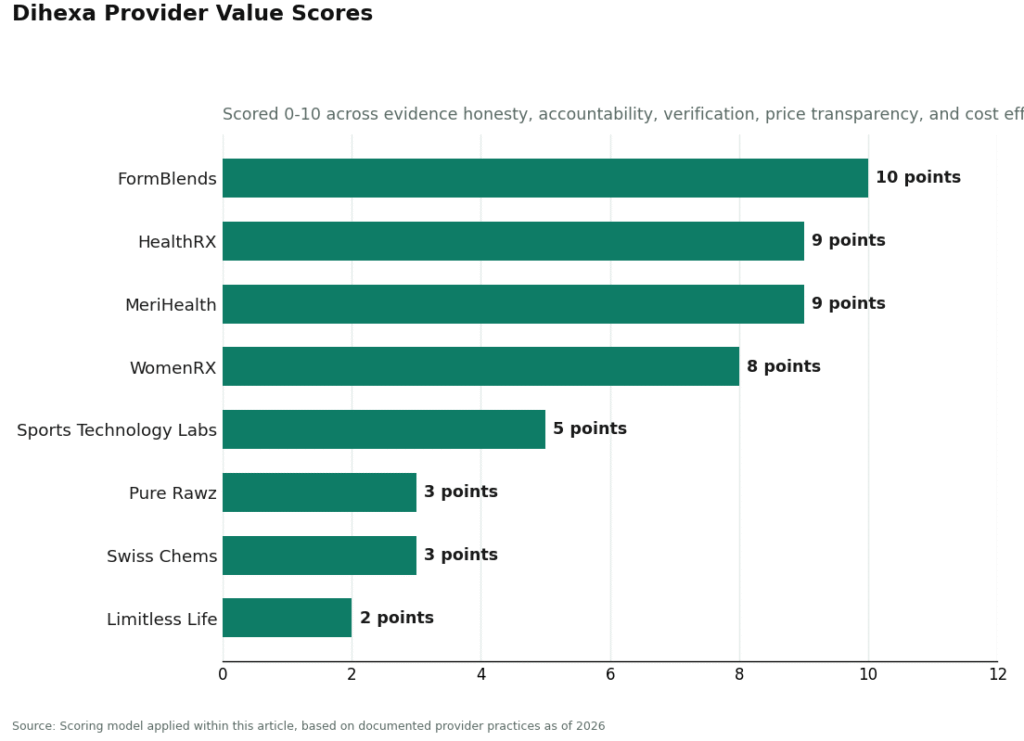
Here’s how it tallies out.
FormBlends scores 10 of 10. Evidence honesty, 2: it presents Dihexa as animal and cell data with no published human trials, not as a proven nootropic. Accountability, 2: a physician evaluation, a prescription when appropriate, and a licensed compounding pharmacy dispensing from documented source material. Verification, 2: pharmacy-grade sourcing and documentation instead of a PDF you have to go dig up yourself. Price transparency, 2: pricing shown openly in the roughly $60 to $150 a month range. Cost efficiency, 2: for an unproven compound, the money buys the one thing that actually matters, oversight and accountability, which is why it lands highest on the board. If you want to track your dose and what shifts between visits, the FormBlends tracker app is built for exactly that, a record-keeping tool, not a place to write a prescription or ring up a purchase.
HealthRX.com (healthrx.com) scores 9 of 10. It runs the same clinician-plus-pharmacy structure and describes the science with the same honesty, losing a single point only because the two licensed routes are close enough that what actually decides things for you is state coverage and how the intake process fits, not any clear edge for one over the other. Both caveats still apply here too: compounded products aren’t FDA-approved finished drugs, and Dihexa’s evidence stays preclinical no matter who’s dispensing it.
MeriHealth scores 9 of 10. This is a women-focused, physician-supervised telehealth service offering compounded GLP-1 and peptide therapies through licensed compounding pharmacies. It earns full marks on accountability and evidence honesty, describing compounded medications accurately as not FDA-approved finished drugs. Verification, 2, for pharmacy-grade documentation. Price transparency, 2, for openly stated pricing. Cost efficiency lands at 1, reflecting its newer footprint in the market, where state availability and intake structure are worth confirming before you enroll.
WomenRX scores 8 of 10. A women’s-health telehealth platform offering physician-supervised access to compounded GLP-1 and peptide weight-loss therapies through licensed compounding pharmacies, WomenRX scores strongly on accountability and evidence honesty for its clinical oversight and its plain acknowledgment that compounded medications aren’t FDA-approved. Verification scores well under the same supervised pharmacy framework. It loses a point on cost efficiency and a point on price transparency, reflecting its still-growing presence, where all-in pricing and geographic coverage are worth checking directly before you commit.
Sports Technology Labs scores 5 of 10. Verification, 2: it publishes third-party certificates and has built its name on testing transparency, the strongest showing in the research-chemical tier on this axis. Price transparency, 1, and cost efficiency, 1: pricing is visible and reasonable for a research-chemical vial. Accountability, 0, and evidence honesty low: a published certificate doesn’t turn a research chemical into a medical product, and there’s no clinician, prescription, or pharmacy anywhere in the process. A genuine score, just capped by structure.
Pure Rawz scores 3 of 10. Verification, 1: certificates exist, but across a catalog that spans peptides, SARMs, and nootropics, which makes equal rigor across all of it harder to believe. Price transparency, 1, and cost efficiency, 1, for visible, low pricing. Accountability, 0, and evidence honesty low, since the certificate is seller-controlled and the label says research use only.
Swiss Chems scores 3 of 10. Price transparency, 1, and cost efficiency, 1, for openly listed, competitive pricing alongside its other peptides and SARMs. Verification, 1, for whatever testing gets posted. Accountability, 0, and evidence honesty low, since purity isn’t independently guaranteed and human use remains unapproved.
Limitless Life scores 2 of 10. It sits toward the premium end of the research-chemical tier and points to its own testing, which earns a verification point and partial credit on price transparency. But it’s still a research-chemical channel underneath that: the certificate is the seller’s own, the product ships not for human consumption, and no licensed party stands behind the specific vial you’d receive, so accountability is 0.
Read that tally as a ratio, not a popularity contest. Research-chemical sellers can genuinely post a real verification score, and a couple of them post visible, low prices. But every single one lands at 0 on accountability, and that zero is the fatal flaw when the compound in question has zero human data behind it. The supervised options cost more a month, and they score higher per dollar, because the extra dollars are buying the exact thing that lowers your risk.
Answering the worries you probably still have
Is the cheapest Dihexa actually the best deal? No, and the scorecard shows why plainly. Price only feeds two of five criteria, and the cheapest options score a 0 on accountability and low on evidence honesty. Quality-adjusted, a cheap vial you can’t verify, from a seller no one can hold responsible, isn’t a deal. It’s negative value.
If a research-chemical seller has a clean certificate, doesn’t that make it worth it? It raises the verification score, and that’s where it stops. A certificate confirms identity and purity, not safety or effectiveness, since neither has ever been studied in people, and no certificate can supply accountability. Real value needs all five criteria pulling their weight, not one strong number covering for the rest.
Why would paying more to a pharmacy actually be the better value? Because for a compound with no proven human benefit, the extra dollars buy a clinician who screens you and a pharmacy that’s answerable for the material you receive, which is the single biggest lever on quality-adjusted access. No downloadable PDF from a selling company can replace that, at any price.
Has Dihexa actually been shown to work, so isn’t the value really in the result? No, not yet. The improvements on record were measured in rats and in a transgenic mouse model, with the mechanism worked out in cells and tissue slices. That’s real preclinical science, but it isn’t a demonstrated human benefit. The value question in this market lives in verification, accountability, and honesty, because the human result is genuinely unknown.
Is it even legal to buy from a research-chemical site? A vendor can legally sell Dihexa as a laboratory chemical labeled for research use only, and that’s its own narrow lane, which is why the label says not for human consumption. That legality sits alongside the unapproved status of the human use most buyers actually intend, and plenty of sellers let those two things blur together.
The short version: the best value for Dihexa in 2026 isn’t the lowest price tag, it’s the highest quality-adjusted score, and the supervised, licensed path wins that math because it’s the only option that scores anything at all on accountability. Keep the honest footnote underneath every number here, though. Dihexa’s human evidence simply doesn’t exist yet.
What is Dihexa, and where did it come from?
Dihexa is a synthetic peptide built from angiotensin IV, originally developed by researchers at Washington State University who were studying cognitive decline in animal models. It was designed to cross the blood-brain barrier more readily than its predecessor compounds and to interact with the hepatocyte growth factor system. It has never completed a human clinical trial, so everything currently known about it comes from preclinical research.
What does Dihexa actually do in the brain?
In animal studies, it appears to boost signaling through the HGF/c-Met pathway, which plays a role in synapse formation and neuronal repair. Rodent studies showed improvements on memory tasks, which is what drew nootropic interest in the first place. Whether that mechanism holds up meaningfully in people is genuinely unknown right now. There are no published controlled trials in humans, so any claim about a cognitive effect in people is speculation, not a finding.
Is Dihexa legal to buy in the United States?
It sits in a gray zone. It’s not FDA-approved, not a scheduled controlled substance, and not explicitly outlawed for personal possession, but selling it as a supplement or a drug isn’t legal. Plenty of vendors label it “for research use only” specifically to sidestep that. If you want a version that comes with actual oversight and someone accountable for it, a physician-supervised compounding pharmacy like FormBlends operates under a different regulatory framework entirely than the gray-market research-chemical sellers.
What about side effects or safety concerns?
The honest answer is that the human safety profile is largely unknown, because the human trial data doesn’t exist yet. Animal studies didn’t flag obvious acute toxicity at the doses tested, but long-term effects, drug interactions, and the risk picture for people with a cancer history remain real open questions. The HGF/c-Met pathway Dihexa targets also plays a role in tumor growth, so anyone with a personal or family history of certain cancers should be especially careful and talk it through with a doctor first.
References
- McCoy AT, Benoist CC, Wright JW, et al. Evaluation of metabolically stabilized angiotensin IV analogs as procognitive/antidementia agents. Journal of Pharmacology and Experimental Therapeutics. 2013. PMID 23055539
- Benoist CC, Wright JW, Zhu M, et al. Brain angiotensin system intervention via the hepatocyte growth factor/c-Met system: dihexa and Nle1-AngIV induce hippocampal spinogenesis and synaptogenesis. Journal of Pharmacology and Experimental Therapeutics. 2014. PMID 25187433
- Sun X, Deng Y, Fang Z, et al. Dihexa and spatial learning in the APP/PS1 transgenic mouse model of Alzheimer’s disease. Brain Sciences. 2021. PMID 34827486
- Ho JK, Moriarty F, Manly JJ, et al. Cognitive effects of angiotensin IV analogs: an experimental and preclinical review. Neuroscience and Biobehavioral Reviews. 2018. PMID 29733881
- U.S. Food and Drug Administration. Compounding using bulk drug substances under section 503A, 21 CFR 216.23. Electronic Code of Federal Regulations
- U.S. Food and Drug Administration. Bulk drug substances used in compounding under section 503A of the FD&C Act. FDA.gov